Hello,
is the following method valid to measure the equivalent resistance for ESRs in parallel?
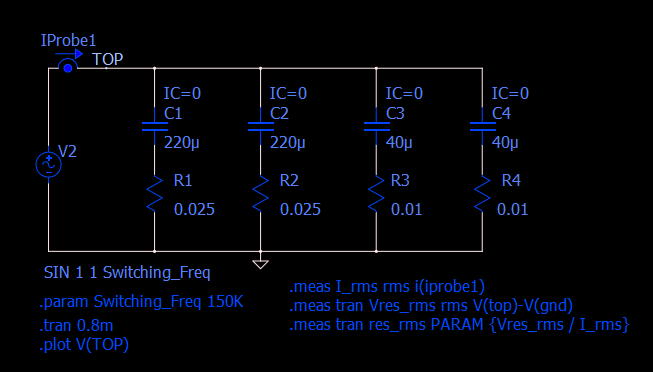
measure_parallel_Cap_and_ESR.qsch (7.2 KB)
Hello,
is the following method valid to measure the equivalent resistance for ESRs in parallel?
measure_parallel_Cap_and_ESR.qsch (7.2 KB)
For ESR or any kind of impedance analysis you will also need to know the current to voltage phase angle
Ok, and once known, what do I do with this value?
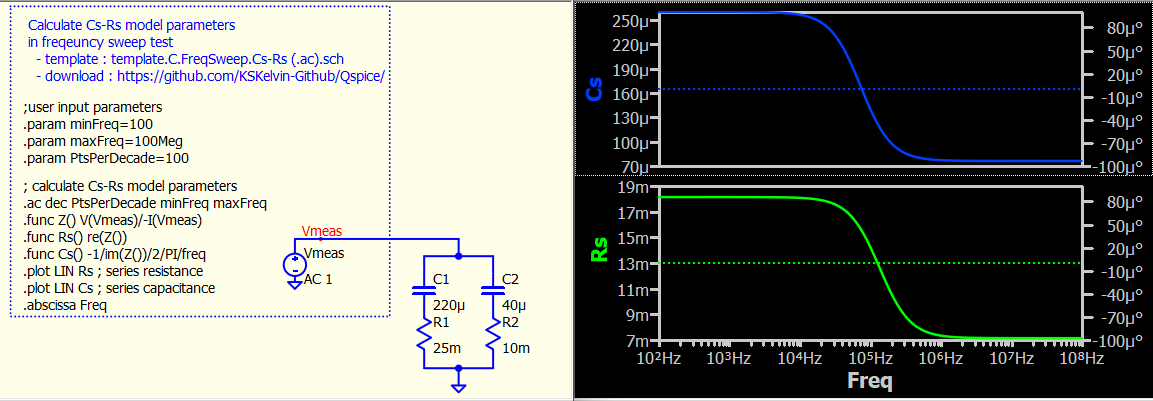
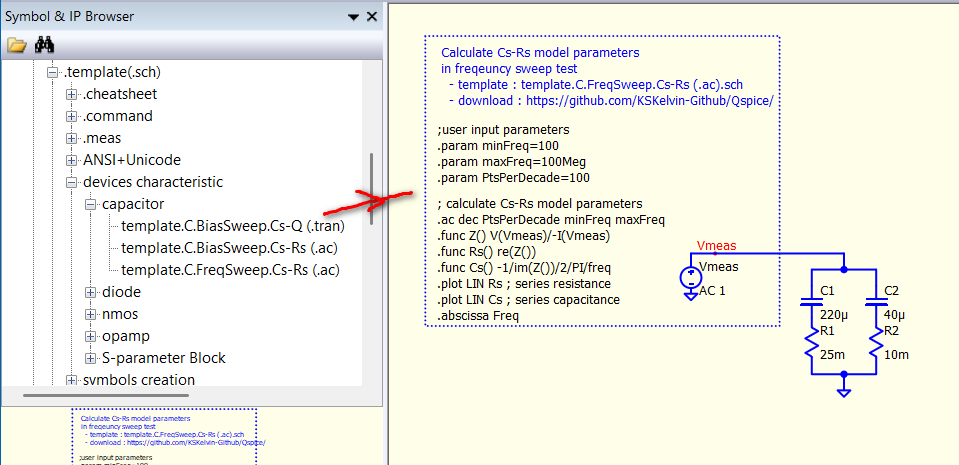
If you need this template, search and download template.C.FreqSweep.Cs-Rs (.ac).sch in my Github : https://github.com/KSKelvin-Github/Qspice
No single value can represent the equivalent Cs-Rs if the parallel C and R are not identical.
If capacitors not voltage- or current-dependent, voltage and current play no role in affecting the equivalent Cs-Rs since this is linear model. We use an AC source to sweep through frequencies and read Cs-Rs at each frequency. This is what a precision LCR meter or impedance analyzer does in the lab.
If you are only interested in a single frequency, simply read Cs-Rs at that point to find the equivalent series parameters for that frequency.
Thank you for replying to my post with a solution.
Ok. Would it then be valid if the equivalent resistances were obtained for each “different” either single or in parallel combination (same values of course) and only then add them in parallel as you would parallel resistors? For example, referencing my original post, if I obtain the equivalent resistance for the two 0.025 Ohm resistors (same values) and the two 0.01 Ohm resistors (also same values), can I then add the results in parallel?
Ahh, good insight. Thank you for this nugget.
As always, you’re a lifesaver! 
Thank you.
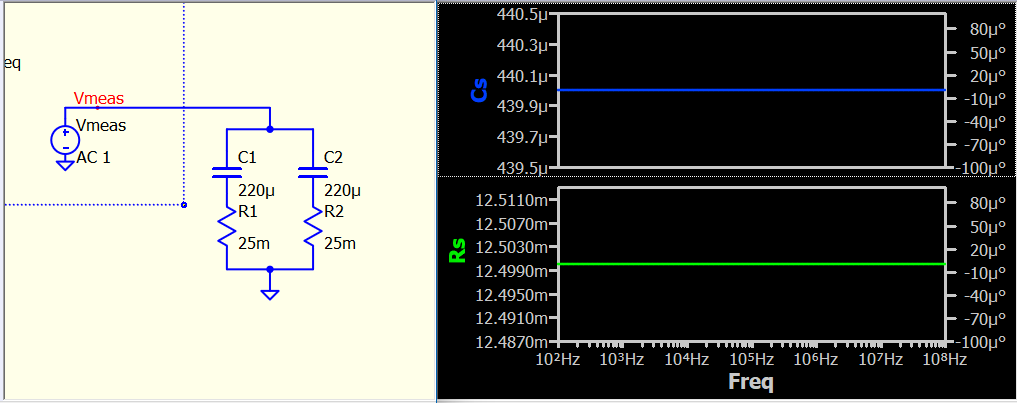
I am not sure if I understand. If you are referring to exact, identical parallel capacitors, since the midpoint is virtually connected, they are simply in parallel, where Cs=220u//220u=440u and Rs=25m//25m=12.5m. However, if anything makes them non-identical, it affects the overall frequency response. You can experiment with the template I provided to get more insight.
The reason I saved this file with a .sch extension instead of .qsch is that the Qspice Symbol & IP Browser recognizes .sch files and supports drag-and-drop functionality. Since this file is part of my custom library, I can quickly drop this template to run simulations.
Yes, when I opened up File > Open …, it specifically looked only for .qsch type files. I had to select the All Files type for the file to become visible.
here is a reference about .sch in Qspice
New Feature: View and Drag Schematic Files (.sch) from Symbol & IP Browser - QSPICE - Qorvo Tech Forum
Thank you for the lead.