Hello,
I am testing the TQP9111-PCB2600 evaluation board. The initial results look good, however I am finding a few performance metrics not aligning with datasheet parameters.
These are my test conditions:
• Input frequency= 2394MHz, CW
• Vcc and Vaped = 5V
I determined that the output P1dB is about 31.8dBm while total current draw is almost 1A, which is almost twice as much as the 545mA Total Current parameter in the datasheet. Actually without any RF input signal, the total current draw is already 560mA @ 5V Vcc=Vpd.
My questions are:
Do my measurements/observations make sense?
Does the evaluation board require tuning in order to achieve the datasheet parameter?
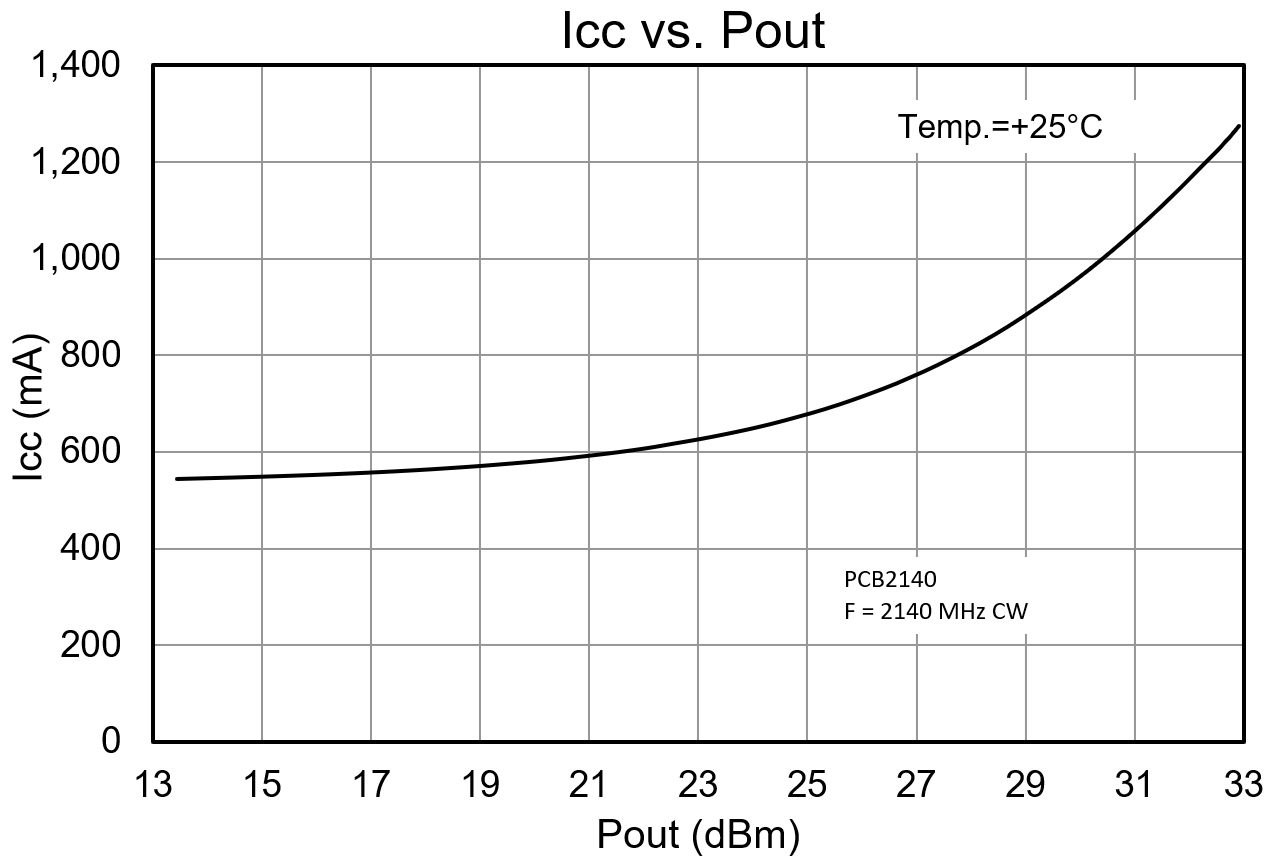
The current specified in the datasheet of 545mA typical is quiescent, so with no RF signal applied. Below is a plot of typical current vs output power for the TQP9111 2140MHz eval board which should give you a good idea what to expect. Current of 1Amp at 31.8dBm seems reasonable. The P1dB you measure seems slightly low. As you are testing CW it is worth cooling the board as if the device is getting hot the P1dB will drop. Once you take into account temperature, PCB loss and part-part variation then your results are probably OK. Worth checking all your calibrations are correct for cable losses. You should not need to tune the board.
Hello Chris_LS, thank you for confirming the current draw, and confirming that the board should not need tuning to get the expected output P1dB. Hopefully on the prototype we designed, it will not need tuning. I will also re-check my input and output calibrations, and pay attention to keeping the circuit cool.
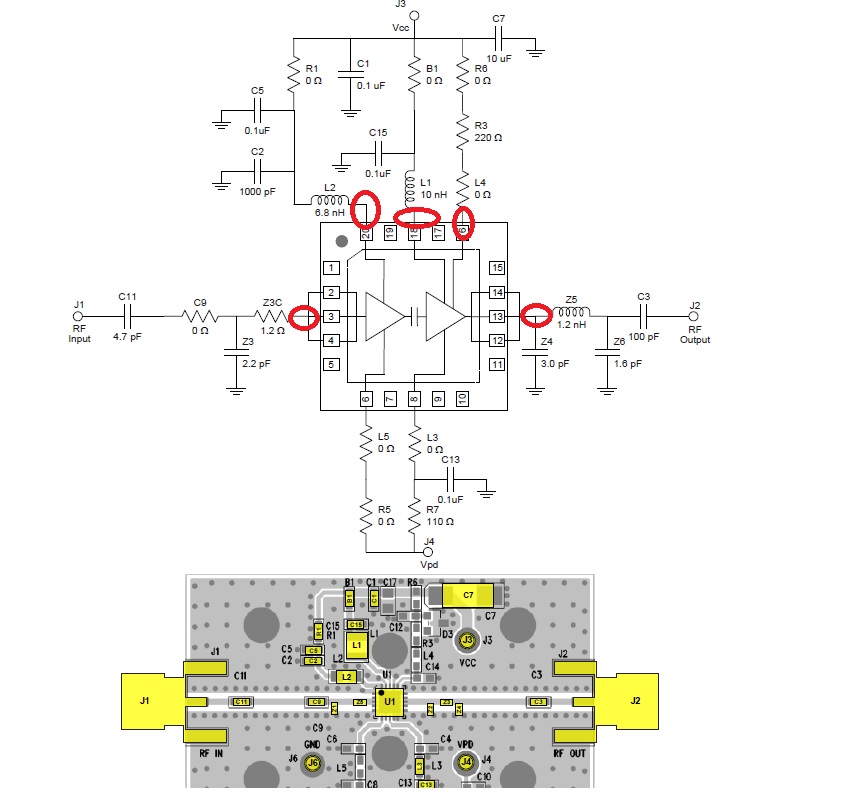
Speaking of the prototype we designed, other than the 50-ohm transmission lines at the input and output, are there any other sections of critical trace dimensions? Do the bias feedpoints at pins 16, 18 and 20 need to be certain impedance and electrical lengths? How about the sections immediately at the signal in and out? I am attaching a screenshot highlighting the sections of concern (see red circles).
My prototype board has very low output power: about +23dBm with an input of +3dBm. Hence I am confirming performance of the evaluation circuit as a start to the debugging.
Thank you in advance for your input.
The position of all tuning components on the RF input and output is critical, the line lengths form part of the matching. The same goes for the position of L1 and L2 and associated decoupling, but these are not quite so important.
If your own PCB uses a different dielectric and board height to the Qorvo eval board you would need to scale the distances. This is to maintain the same electrical length at the frequency of interest.
If you need any more detailed support with the tuning then please contact appsupport@qorvo.com stating your company name and location.
Thank you for the important details.
I tried to contact appsupport@qorvo.com but the email bounced back. It got blocked. Here is the message received back: The response from the remote server was: 554 5.7.5 Permanent error evaluating DMARC policy
Any reason why that is? I did state my company name and city+country in the email.
Hello,
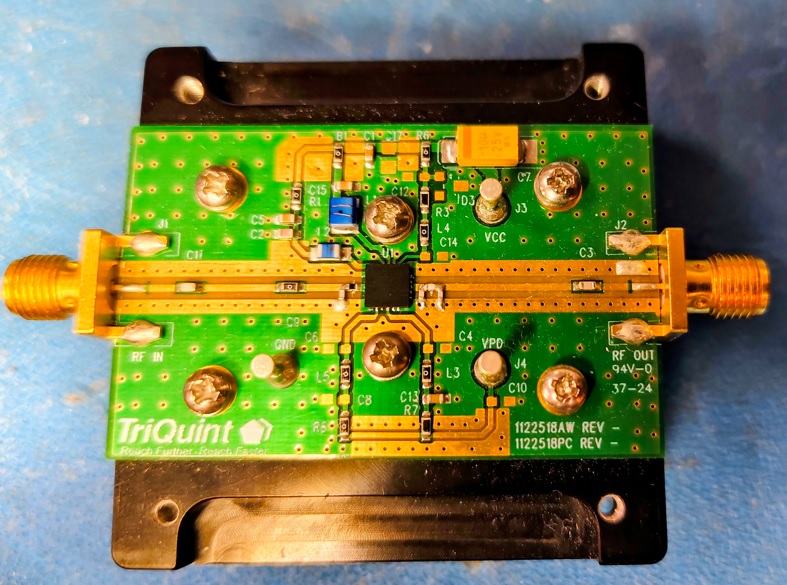
For the evaluation board, I noticed the locations of the match components at the input and output are different between the datasheet and the physical board. Please see the attached picture, then compare to the datasheet drawing on my earlier post.
Are each physical evaluation board custom-tuned (hence the difference in locations between the datasheet vs. physical board)? For my own PCB, which should I follow? Thanks!
I believe you may have taken the board image from an earlier datasheet revision. Check out TQP9111 datasheet Rev I which looks like the photo of your board.
Yes! Thank you for pointing out my mistake. I did obtain the evaluation board image and schematic from the Rev E datasheet dated 2015. Not sure where I got it from.
On my own PCB, I will now scale the distances of critical sections because the dielectric material and board height is different than that of the evaluation board. I would like to confirm with you regarding the following:
Is the evaluation board’s dielectric material Nelco N4000-13, with Dk of 3.4 to 3.7?
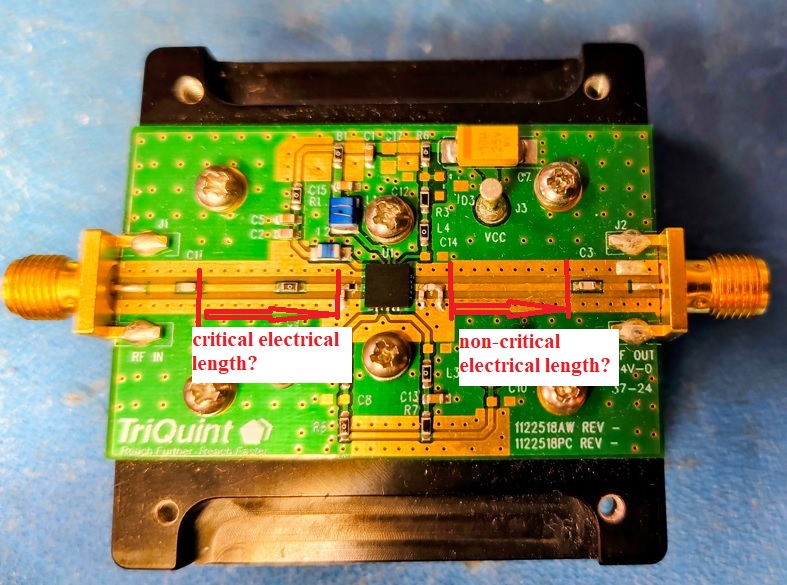
Is the RF input distance between C11 and Z3 critical? See attached image for details
Is the RF out distance between Z6 and C3 non-critical (C3=100pF being a short at 2394MHz)? See attached image for details.
Yes, Nelco 4000-13, see attached PCB fab drawing. 1122518pc.PDF (180.0 KB)
C11 is 4p7 which has some effect at 2600MHz, so it’s position will be important to input match.
Position of C3 is not critical.
On my own PCB, it is unlikely I can use Nelco 4000-13. We will have to continue using high-temperature FR-4. Do you see a problem with using FR-4 for the TQP9111 at 2400MHz? Do you know if other people have successfully used FR-4 for this type of application?
Thanks!
N4000-13 is lower loss than FR-4, and will also give tighter impedance control. FR-4 is widely used at 2400MHz, and is very cost effective. If trace lengths are short then FR-4 is likely to be fine. I would recommend that you select PCB stack up, PCB height and position of internal ground layers, to give you a similar 50R line width to the TQP9111 eval board.