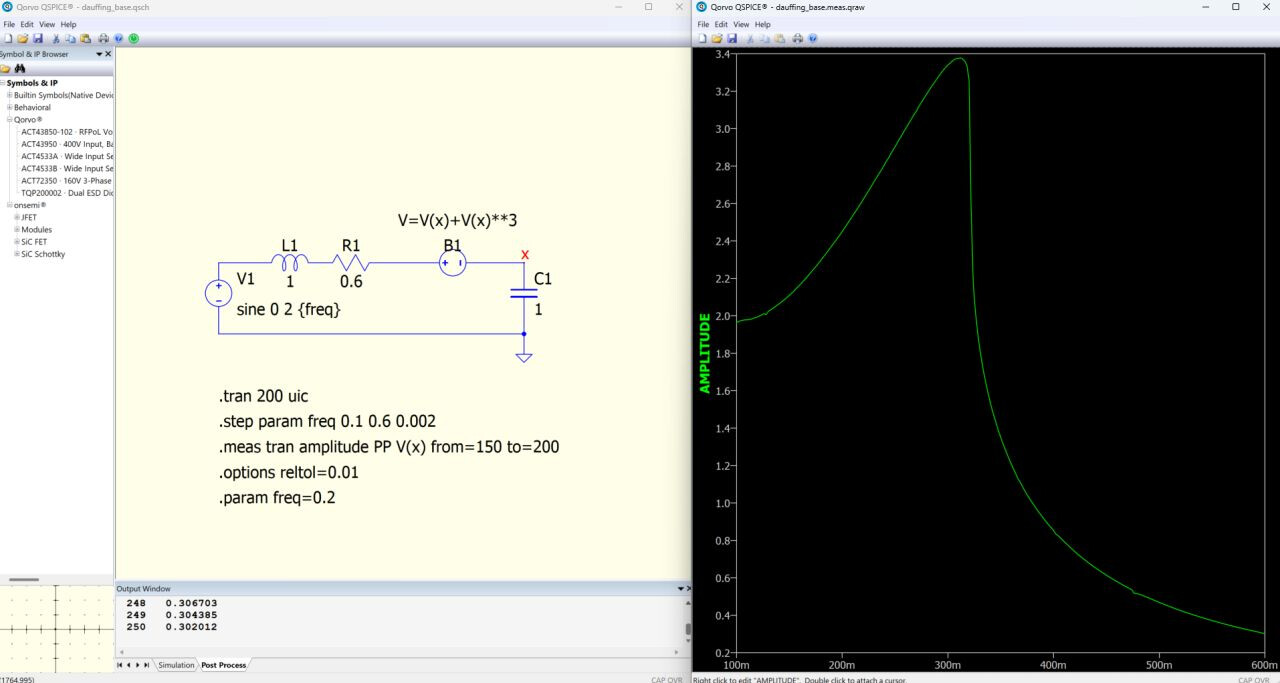
For this week’s QSPICE schematic capture, we have a circuit by Shivansh Madan, related to MEMS Device Simulation. According to Shivansh:
QSPICE has proven itself to be a popular tool in the analog and mixed-signal design space, but can it be used for MEMS device simulation? In transducer design, we often face a trade-off between modularity and fidelity. A custom MATLAB script can numerically solve governing differential equations, but it often obfuscates the intuitive behavior of the system. Conversely, high-fidelity Finite Element Analysis (FEA) captures exact geometry but is notoriously cumbersome to iterate upon.
Equivalent circuit modeling in SPICE offers a powerful middle ground. By leveraging electromechanical analogies, we can map stiffness, damping, and resonance directly to circuit parameters. Modern tools like QSPICE have pushed this further than ever, offering the robust behavioral modeling needed to bridge the gap between abstract physics and circuit-level implementation.
I haven’t seen anyone else document the Duffing nonlinearity in QSPICE yet, so I decided to push the solver’s limits. By implementing cubic stiffness terms directly through behavioral sources, I was able to replicate the characteristic “shark-fin” resonance tilt and the sudden jump phenomenon that defines spring hardening.
The real strength of this approach is scalability. By cascading these Duffing blocks into a transmission line structure and introducing a quadratic term, I was able to generate a dense, stable frequency comb. The QSPICE engine is remarkably robust here. For anyone working at the intersection of MEMS micro-structures and Digital Signal Processing with readout electronics, this level of flexibility is a game-changer. I’ve shared the .qsch files and the implementation logic in my GitHub repo for anyone who wants to experiment with non-linear blocks in QSPICE: https://github.com/smadan755/QSPICE_DSP/tree/main.
Please send any submissions to me at tim.mccune@qorvo.com. (Schematic Capture Post #078)