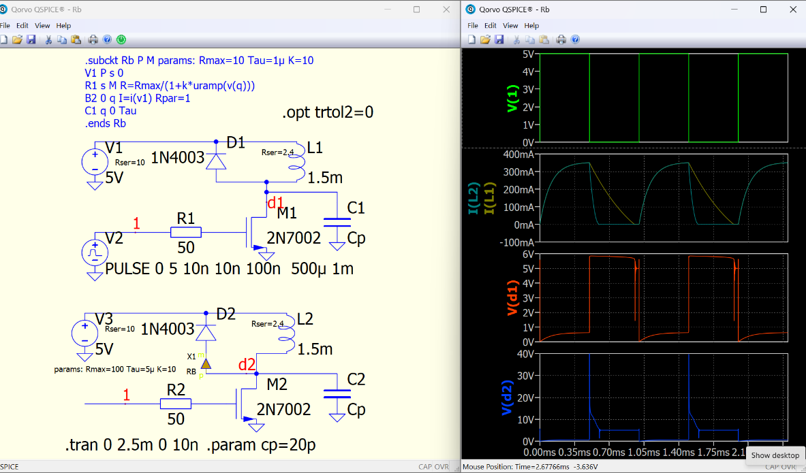
An interesting discussion from our friend Alexander. “Diodes do not always turn on instantaneously.” During a fast current pulse, a diode may briefly exhibit a substantially higher voltage drop than its normal steady-state forward voltage—a behavior known as “forward recovery”.
This effect is not fully represented by conventional built-in SPICE diode models. Before sufficient charge carriers develop within the diode’s base region, its effective resistance remains elevated. As carriers accumulate, the resistance falls and the forward voltage settles to its expected level.
This QSPICE simulation introduces a custom helper element connected in series with the diode to reproduce that transient behavior. The plots compare the standard diode model with the enhanced model and clearly show the initial forward-voltage overshoot.
The model was inspired by a practical laser-driver experiment. During testing with a pulsed 1 A current source, the laser was replaced by four series-connected 1N4007 diodes to protect it. When each pulse began, an unexpectedly large voltage initially appeared across the diodes before declining to the normal forward drop. The custom helper element successfully recreates that real-world effect.
Another example of using QSPICE to extend conventional component models and investigate behavior that might otherwise be missed.
Schematic Capture Post #106
Rb.qsch (10.7 KB)
. Please send schematic submissions to tim.mccune@qorvo.com.