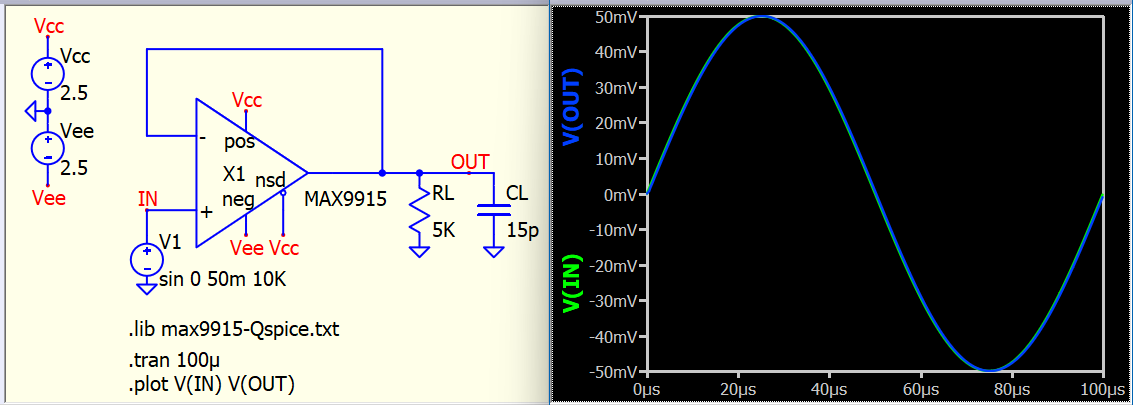
Electrode_drive_Rload.qsch (18.7 KB) max9915.TXT (5.4 KB)
I’ve tried playing the model (with chatGPT’s help) and could not figure out why it is not working. It is as if the MAX9915 is in shutdown mode. The current state of the model tried to bypass the shutdown logic, to no avail.
I then recreated the circuit in LTspice, and it worked as expected. I’d appreciate any help I can get.
QSpice requires Ron to have a finite value for a diode to use the behavioral diode equation; otherwise, it will use the conventional SPICE semiconductor diode equation. If Ron=1m is added to the .model DI statement, QSpice can output a waveform.
Well, if you are working with Analog Devices components only, I still recommend that you use LTspice, as many ADI models use unique device syntax that is only supported in LTspice.
Thank you for the reply. It is unfortunate that ADI models may force me use LTspice–I figured since Mike wrote both tools, their models would always be compatible (Qspice would always understand anything written for LTspice). Maybe someone knowledgeable could write a “model translator” to enable us to use Qspice for all models (or even undestand Pspice macro models as well). Thanks again for your response.
I can translate models. It is possible, but very complicated, and I have to write a program to translate A-devices. I tested it with multiple models and the results were good (but not support .noise analysis).
However, the real problem is that companies tend to encrypt their models nowadays, and you won’t get support for ADI models outside of LTspice. That’s why I recommend that if anyone must work with ADI models, they should just continue using LTspice. But if it’s just an op-amp or a simple device, just take any behavioral model and work in Qspice.