JFET op-amp ADA4610.qsch (10.1 KB)
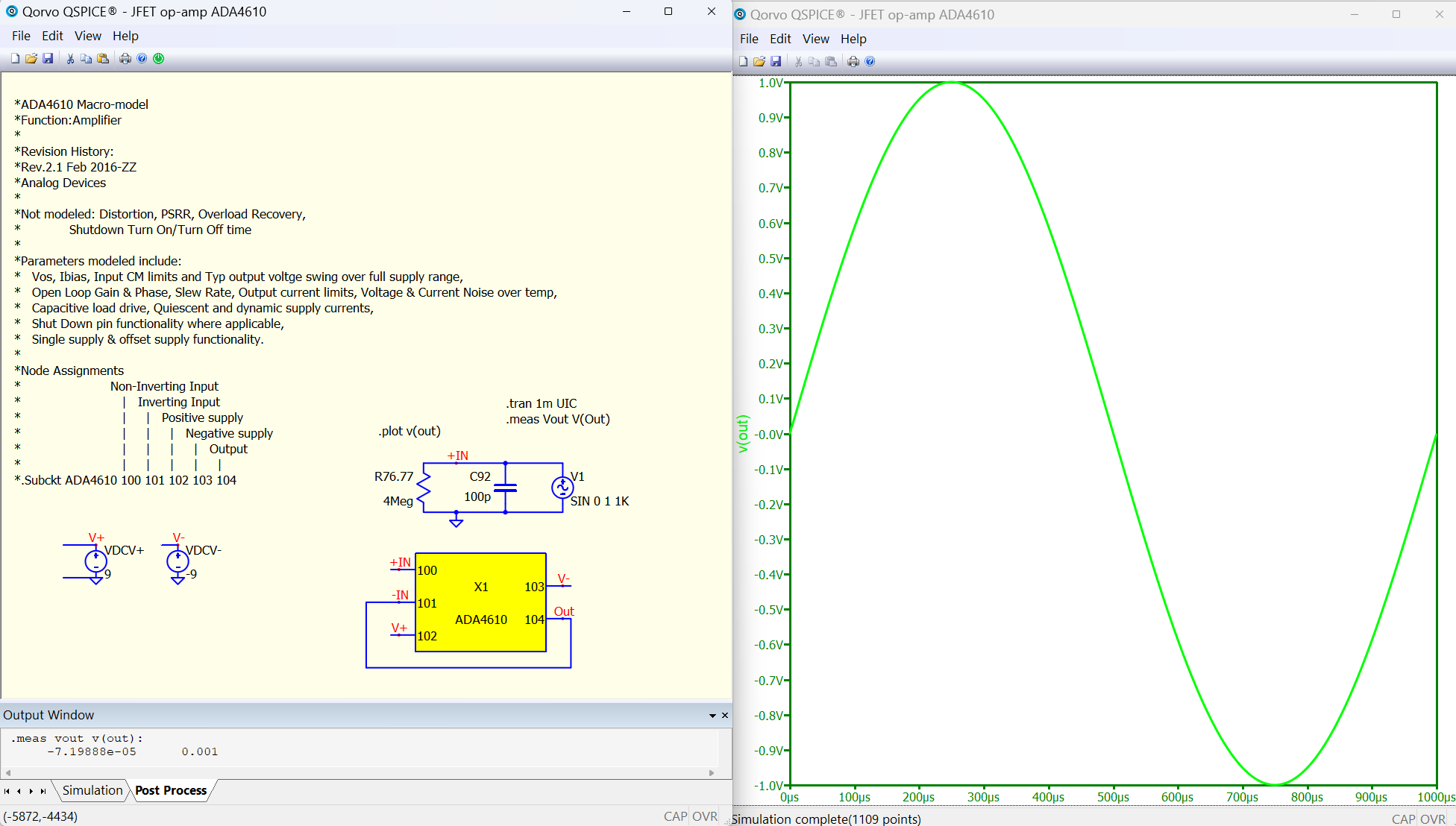
Used shift+ctrl+v to import netlist and automatically create block
the netlist looks ok
but it generates errors:
Warning: Gmin stepping failed.
Starting source stepping.
Warning: Singular matrix. Check nodes VOUTP1•X1#BRANCH and 63•X1
Warning: Source stepping failed at 0.747106(1.74406e-16)
Starting pseudo transient analysis.
Warning: Singular matrix. Check nodes E2•X1#BRANCH and 112•X1
Warning: Singular matrix. Check nodes VOUTP1•X1#BRANCH and 73•X1
Pseudo transient analysis failed.
Warning: Using skipbp
Warning: Singular matrix. Check nodes 113•X1 and VOUTP•X1#BRANCH
Kelvin (or any other very experienced user), how do we fix this?
The problem is that QSpice failed to resolve the DC solution using all available DC strategies (Direct Newton, Gmin Stepping, Source Stepping, and Pseudo Transient).
Add this option to use 80 bits math and seems can resolve the issue: .option fastmath=0 (or Edit > Preferences > Disable Fast (less accurate) math)
Hello,
I had a similar issue with the ADA4625, and many others, reverse engineered the netlist and found something weird. I just tried the same fix with your ADA4610 and it worked from my side.
So comment the line with ePD and add a fixed voltage source:
*ePD    80    113    82    0    1
V113 113 0 dc 0
Please let me know.
Sergio
1 Like
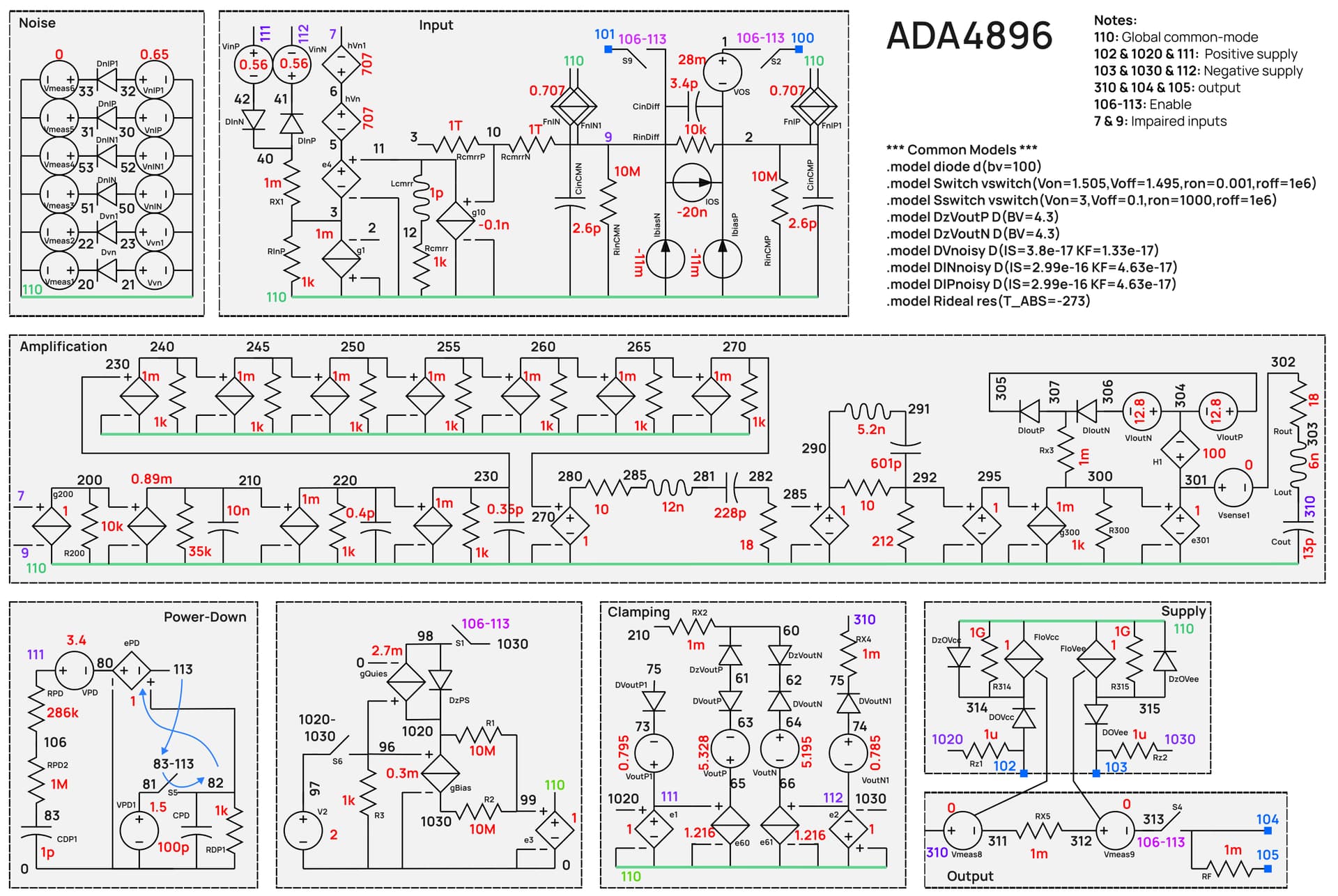
… here’s a graphical view of the ADA4896’s netlist. You can find the exact same structure for several Analog Devices models like the ADA4610, obviously with different parameters.
The problem, in my opinion, is in the Power Down section at the bottom-left, highlighted by blue arrows. All power-down switches in the circuit are controlled by the voltage difference v(106,113). But node 113 depends on node 82 which depends on node 113. Qspice fails to resolve that loop.
You should therefore expect the same issue with several models.
1 Like
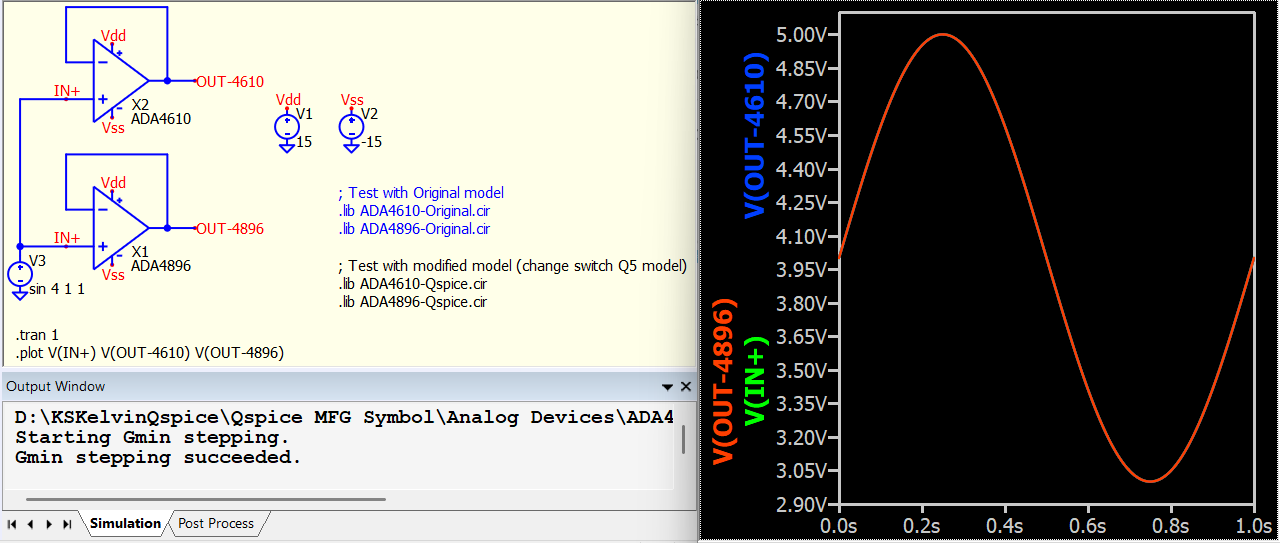
@sergio.pesenti I’ve seen QSpice have a hard time solving DC solutions related to switches, but that rarely happens nowadays. In this case, changing the switch model from a smooth-transition switch to a hard-transition switch also can help resolve the DC solution; I tested this with the ADA4610 and ADA4896.
Original
.model Switch vswitch(Von=1.505,Voff=1.495,ron=0.001,roff=1e6)
Modified
.model SwitchQ vswitch(Vt=1.5, Vh=0, ron=0.001,roff=1e6) ;for Qspice(.dc)
ADA4610-Original.cir (7.5 KB)
ADA4610-Qspice.cir (7.7 KB)
ADA4896-Original.cir (5.7 KB)
ADA4896-Qspice.cir (5.8 KB)
LTspice-Opamp-Template.qsch (5.8 KB)
@KSKelvin Just tried. Thanks for the hint.
Kelvin, this is working well. Thanks for sharing the tweaked cir file.
This project also includes an LED featuring Gallium Arsenide Phosphide semiconductor. I was going to use the model generator to create the device in QSPICE. But the closest match is GaAs. If it’s feasible to use as a substitute, what would the drawbacks be?
@poushag Update QSpice; no tweak is required for running this schematic now.
05/07/2026: Adjusted the voltage-controlled switch’s Newton damping.
@sergio.pesenti I tested both the ADA4610 and ADA4896 with the unmodified AD models, and they both solve the DC solution now. Thank you for sharing your tweak and the detailed circuit diagram; without those, couldn’t have narrowed the root cause down to that voltage-controlled switch. BTW, circuit diagram is impressive, which software it is?
@KSKelvin Hey Kelvin,
My pleasure to contribute. 
Many many thanks to you for your precious support.
At first I thought there was something not converging in the amplification part.
That is why I started painfully reverse-engineering the netlist.
I did the power down section last, just to discover that the issue was there.
But it was worth it doing the exercise.
I use inkscape for hand sketches, no special magic there.
Would love sharing the svg file but I am apparently not allowed to upload such file on this platform.
2 Likes
QSpice is a one-man job; Mike works on it alone. Therefore, it is very important to rely on community effort to make things better. I’m glad we have dedicated members working together!
1 Like