I want to implement UWB RTLS solution for a huge Yard in Steel Manufacturing industry. That yard size is around 400 M length, 100 M breadth & 15 M height & has 7000-8000 assets at any time. These assets are of Steel Sheet Rolls,/Steel Wire Rolls etc.. each weighing 2.5 tonnes.
I tried using DWM1001 as anchors & tag with 12M apart in rectangular shape (24M X 12M Area). But I didnt get proper X, Y, Z values.
I think that the range covered by this DWM1001 is not sufficiant of this environment. Is there any other model which can cover longer range? Or is there a way to increase the range in this by adding external antenna?
Does “yard” mean outside or inside? Is it under roof of open air?
Does the 15m height number suggests the items could be stacked on top of each other? Is there some sort of racking system in use?
An example picture of the items in the yard could be enlightening and lead to better guidance for you.
Given these metal objects, the specifics of how the tags are attached will be critical. A tag that sits at the top of the object will have a chance, tags on the sides or inside a roll are probably close to hopeless.
The specifics of the setup are critical to understanding your failure.
The most important thing is to imagine the signal from the tag to the anchors and what does it pass through. If that is blocked by the objects, you won’t get good results.
The DWM1001 modules don’t have the best antenna and they aren’t equipped with an LNA to aid performance, so the range is limited.
All of our CUWB devices have a better antenna, with LNA and front end filter. On channel 5 we easily achieve 100m distances. So UWB can cover that distance if you have the right system.
I suspect range is perhaps not your main issue, though, signal occlusion might be a more difficult thing to fix. Again, this depends on the details of tag and anchor placement.
I have another concept you can consider. This takes into consideration the characteristics of your use case such as:
Objects don’t move on their own, they only move by machine.
You have a lot of tags you need, so low cost item tagging is beneficial.
The items create problems for radio waves being metal and large.
Step 1 of the idea is to track the machine that moves the items. This could be by RTK GPS (if outdoors), or by UWB. While using UWB seems like it introduces the same issues, the machine is usually easier to track well since you can optimize the UWB tag placement on it. You can also put multiple tags on the machine to provide diversity and redundancy. So UWB tagging the machine is often far more reliable than the items.
Step 2 is to identify the items when they are on the machine. If they have a readable bar or QR code, that could be done optically and makes tagging the items very cheap and may already exist. It could be done with a cheap BT tag that comes alive based on motion with a BT receiver on the machine. It could be done with UWB tags and the machine can read UWB as well. The basic requirement is that any item that is picked up by the machine is identifiable by the machine. Since you have 8000 items, finding a cheap way to track/tag them is a major win.
Step 3 is pick/drop detection. For the barcode, when the code is readable, the item is picked, and when it is no longer read, it is dropped. For the BT or UWB tag, comparing the motion of the tag to the machine (using inertial sensors) lets you know when the item has been picked or dropped. BT RSSI can be used here but can be unreliable at times. UWB could use TWR to verify load is picked/dropped.
Step 4 is a database which keeps track of the item relocations. Basically, the last time the item was dropped is where it is. They won’t move on their own being 2.5 tonnes. The system answers the question “where did I last put it?” versus the usual UWB question of “where is the item?”.
Step 5 (optional) is a verification system. This would be something, say drone or ground vehicle, that drives around and checks the location of items near to it. It can scan bar codes, pick up BT tags, or pick up nearby UWB tags, and then compares the identity of the items and the location to the database. This is designed to catch errors and other issues.
I am not aware of an off the shelf implementation of the above, but it is something my company could develop for you. We’ve done a lot of work with RTK GPS, BT, UWB, forklifts, databases, optical readers, etc.
The above concept doesn’t provide monitoring of the items, say an UWB tag that reports temperature or something like that. If you need monitoring of the item, then you need something else.
Directly tracking UWB tags on large metal objects stack up to 15m high will be challenging. It is not impossible, but it will likely require a dense anchor array and careful tag placement on the items.
Mike Ciholas, President, Ciholas, Inc
3700 Bell Road, Newburgh, IN 47630 USA mikec@ciholas.com
For step 2 I’d consider 900 MHz RFID. It can give a couple of meters range (over 20m in good conditions but these aren’t good conditions). If you were to place a reader on the forklift / whatever moves the items then you could track what was being moved and where it was dropped while keeping the cost per item to a minimum. Waterproof, works stuck directly on metal type tags may cost a lot more than the 10-15 cent basic stickers but they are still cheaper than any other tracker type device and you don’t have to worry about batteries on them. They are generally cheap enough you can afford to put a couple on large items, one on each end incase one side gets shoved up against a wall / other object and blocked.
You can even track which tags you see while driving around and use that information to keep your list of what’s where up to date and flag anything that’s moved unexpectedly.
A couple of readers at the yard entrance / exit can then also be used to either track things in and out or tell you if you forgot to remove the tags depending on your workflow.
The ranging may not be as accurate as UWB (you can use RSSI but it’s mainly a presence detection style system) but from a cost per item perspective and also simplicity in running the system it is a big plus. Battery life may be good for more active tags but within a year or so you’ll have the issue that 8000 batteries need changing / charging.
Thanks for the response.
This is a closed Yard (Is not Open to Sky).
The assets are of 1.5M height & are stacked one above the other (3 layers).
I am planing to have Anchors all around the yard, & Tag on the crane used to keep the assets. These cranes are equipped with a Barcode Reader. When an Item is placed, the barcode is read by the crane & at that time, the Tag position, the barcode & Date time stamp will be sent to the database.
If there is a Powerful UWB solution which has good antenna & range, I hope, we can successfully implement.
The temperature of the Steel item will be high & cannot put the RFID tag at that temperature. They have Barcoding system already. We have to use the barcode & RTLS to locate the barcode.
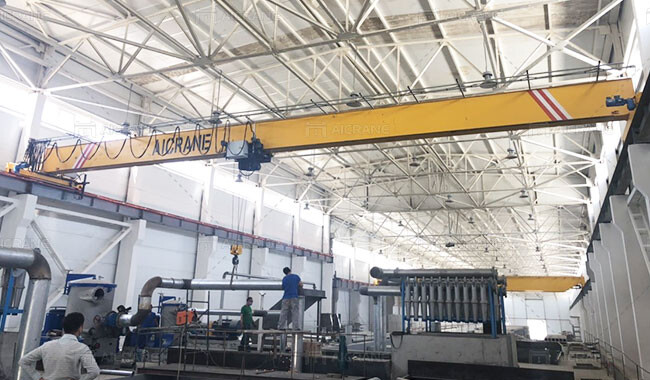
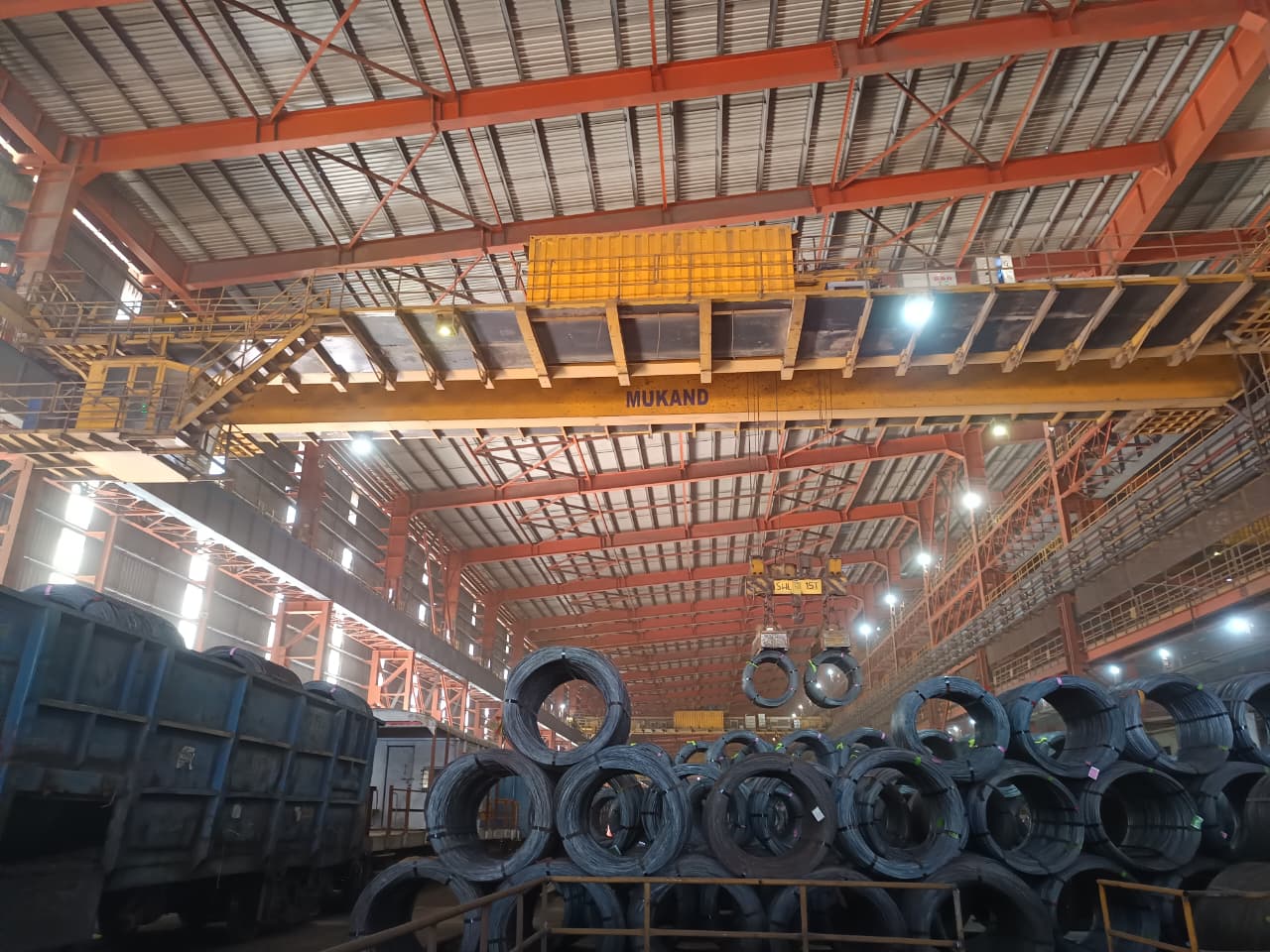
A picture of the crane and ceiling would be helpful to provide further guidance. Specifically, how much clearance is there from top of crane to underside of ceiling, and what does the ceiling structure look like?
Excellent, so the load identification is already in place, you simply need to add location to the system to get full inventory position.
My concept for you:
Install an anchor array on the ceiling. If there is a clear plane for them to be on, you might be able to get away with about 40m spacing since your precision requirements are relatively mild. You can add anchors to achieve whatever precision you want.
I’d put multiple tags on the crane. I’d put 2 tags fixed to the beam so you can track where the beam is in one axis. I’d put 1 tag on the hoist trolley so you can track where that is in the other axis. And I put one tag on the hook so you can track Z axis. If you don’t care about Z axis, you might be able to skip that one.
If these tags have good laterally visibility, that is, not blocked in the horizontal plane, then you will get good performance. The exact details of how to place them matters.
For our products, AN302 anchors can be wired on a chain of 12 per PoE port and thus have no batteries to recharge or maintain. They can be sealed using our mounting box and sealing kit, if dust and moisture are a concern. Assuming a 30m crane span and 40m longitudinal anchor spacing, 12 anchors would cover 7000 m^2 area. For your 40,000 m^2 area, probably need ~70 anchors. This will depend on the exact layout of cranes, walls, etc. The UWB signal does not go though any metal.
The anchor chains can be made redundant by powering the chains from both ends (a CUWB exclusive feature). This means the loss of any cable or anchor doesn’t take down the entire chain, which eliminates the fault sensitivity of chained anchors.
PT301 tags are small but can do the job. At 1 Hz, they last 40+ days in Multirange (TWR) mode, and 100+ days in Multitime (TDoA) mode. That is sufficiently long enough to trial the system, but a longer power method would be useful.
If you had power on the crane, the tags can be powered via the USB-C port so you don’t have to worry about recharging them. This could also be a large external battery if crane power is not workable. This allows you to get any tag battery life you want with an external pack.
Putting in more tags to be redundant would be useful and not a great burden. This way you can suffer a tag failure and keep operating until it gets fixed.
I’d consider Multirange (TWR) mode since your locate capacity requirements are fairly low. I would trial this with 10 Hz tags so you can see if smoothing is useful to increase precision, but 1 Hz tags are likely sufficient in actual use. Multirange mode does not require the anchors be precisely synced which reduces the criticality of anchor to anchor connections. Also, Multirange is better for low anchor density and sensing outside the lateral bounds of the anchor array.
In operation, when the system determines a pick or drop has occurred, record the position of the related anchors for that crane. This will give you a set of locations of the crane in multiple axis.
This could be tested rather quickly. I could imagine using magnetic mounts for anchors and tags (since there is steel all around to mount to) and setting up an experiment in a matter of half a day and seeing what the results are for tracking.
I think you have a viable use case. A few careful details need to be handled for anchor and tag mounting, but this should work fairly well and without extraordinary effort.
Thanks for the response. I liked the idea of Putting a tag on Beam for X axis & hoist for Y axis. I have asked my customer to send few pictures of the yard. I will share them soon.
We are in the process of getting regulatory approval for our devices in India. I don’t have a specific timeline for this, however. The regulations appear to reference ETSI EN 302 065, which we are in compliance with for CE mark, so there’s no technical hurdle to overcome here, just “paperwork”.
Does this mean the rolls can be moved in ways other than by crane? If so, the other methods of movement have to be accounted for in the system. That could mean UWB tracking for these other methods, or it could be rare enough that manual exception entry works.
My initial impression is that UWB would work here very well with a proper system design.
Install an array of anchors in the vertical space above the top of the traveling crane and attached to the ceiling structure. Given the relatively open environment, I’d advocate for sealed anchors which we can provide with our mounting box and sealing kit.
Anchor density would not need to be great given you accuracy requirements are relatively low (say +/- 50 cm?). Anchor spacing about 40 m is probably okay, but this can be tested to be sure. With our 100 m range (channel 5), this puts ~8 anchors in range of the crane at any given time which will easily give you 50 cm accuracy.
I’d install a set of tags on the traveling crane to get the Y axis (in/out of picture plane). I’d install a set of tags on the trolley for X axis (left/right in image). Then tags on the hoist end for Z axis. It looks like the hoist has parts of it well above the load and that would be ideal for tagging since it elevates it above the items when picking from the lowest elevation. Tags are all sealed as well.
It might be sufficient to put tags on the hoist only. This will depend on the upper parts of the hoist being above the rail car side walls, and above nearby stock. Even if this might work, I still favor having crane tags as backup and location check. You can make a relatively simple piece of backend code that will take the set of tags and combine them into one location for your inventory system to consume.
It looks like crane power is basic AC from a sliding rail with all crane controls on the crane itself, which means powering the tags via a USB power source derived from the AC mains would be possible for at least the Y axis if not the X axis. Z axis maybe not so much. The preferred tag for this would be our PT321 which runs on a CR123A cell can can last well over a year at 1 Hz.
You might consider if you need Z axis or not. Another way to get it would be to put an encoder on the hoist, if possible.
I see more than one crane per rail system, which is fine, the UWB system can handle that.
In short, I think UWB tracking should work quite well in this application if done correctly. The primary task is placement of anchors and tags in ways that maximizes the line of sight paths between them.
Mike Ciholas, President, Ciholas, Inc
3700 Bell Road, Newburgh, IN 47630 USA mikec@ciholas.com