Now I can simulate 2 peaks by adjusting the epsV. However, for series connect 3 RTDs, it becomes very difficult. I used different coefficient Gmin to break the symmetry, but its not ideal and often fails.
In reality, RTDs will turn off one by one, but in the simulation, they turn off simultaneously.
Sorry, I cannot load attachment because I just create the account.
This subcircuit is based on your RTD model. It appears that you are attempting to connect RTDs in series, which may lead to convergence issues. I am not smart enough to figure this out. Therefore, I am sharing this circuit for other members to explore.
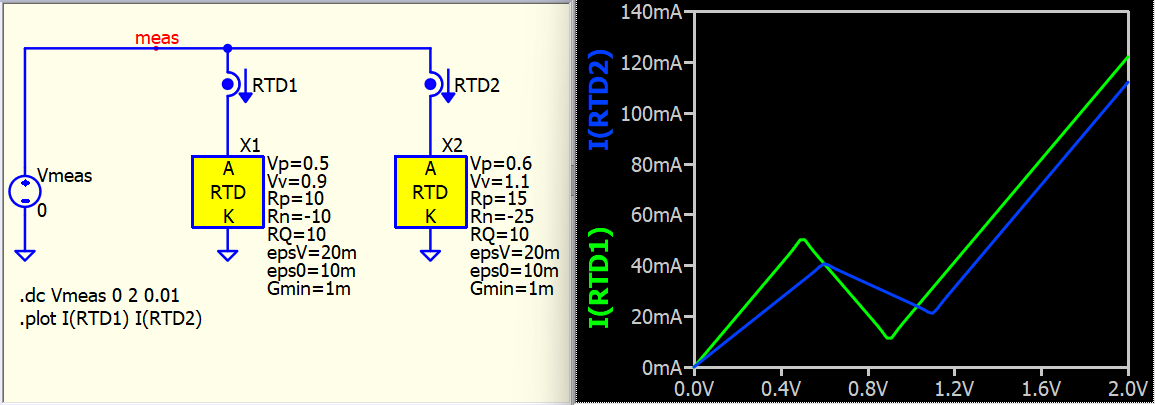
I don’t know about Resonant Tunneling Diodes (RTDs) before this post. This device exhibits a peculiar I-V curve. It is challenging to imagine how this device would behave in series, where their currents are expected to be identical. For instance, in the curve below, if 30mA flows through them in series, RTD1 could exhibit voltages of 297mV, 707mV, or 1.089V, while RTD2 could show voltages of 443mV, 871mV, or 1.188V. Consequently, there are 9 possible voltage solutions for 30mA, such as V(RTD1) + V(RTD2) = 297mV + 443mV or 297mV + 871mV, and so on. As you model it with a voltage controlled current source, I think the simulation will struggle in a multiple solutions condition.
If you use a curve tracer to run a I-V curve for two RTDs in series, what I-V curve you can get?
The RTDs are series connected and should have multi-peak behavior in the image below. I just changed 2nd Gmin to 2m to have a small kick. When current has a jump, the spice may have multiple values, all current values are unstable excepted for one stable solution (two in hysteresis). Spice tend to follow the unstable solution because the current is continuous. But in this case, It requires a external kick to push to value to the stable solution.
I still cannot load attachment, So I just modified your circuit. When you change the Gmin in second subket to 1m, the peaks will merge. image|552x500, 50%
Reference: A. Raychaudhuri, Z. X. Yan, M. J. Deen, and A. C. Seabaugh. 1992. Hysteresis in resonant tunneling diode based multiple-peak driver device for multivalued SRAM cells: analysis, simulation, and experimental results. Canadian Journal of Physics . 70 (10-11): 993-1000. https://doi.org/10.1139/p92-159