Ignoring shorted capacitor: “CI_S1•X2”
Ignoring shorted capacitor: “CI_S2•X2”
Warning: The table function works best with constant values in the table:
“GRBD D1 DD2 VALUE {V(D1,DD2)/RDLIM(RBODY(V(GK),V(TJC)),10M,60M,0.1)}”
Warning: The table function works best with constant values in the table:
“EF ND 0 VALUE {RDLIM(ND(V(GK),V(TJC)),1M,320M,0.01)}”
Warning: The table function works best with constant values in the table:
“G2 D1 S VALUE {IF(V(D3,S)<=0,IF (V(GK)<=V(NET3),0,-DRAIN_CURRENT[…]”
Warning: The table function works best with constant values in the table:
“G2 D1 S VALUE {IF(V(D3,S)<=0,IF (V(GK)<=V(NET3),0,-DRAIN_CURRENT[…]”
Warning: The table function works best with constant values in the table:
“G2 D1 S VALUE {IF(V(D3,S)<=0,IF (V(GK)<=V(NET3),0,-DRAIN_CURRENT[…]”
Warning: The table function works best with constant values in the table:
“G2 D1 S VALUE {IF(V(D3,S)<=0,IF (V(GK)<=V(NET3),0,-DRAIN_CURRENT[…]”
Warning: The table function works best with constant values in the table:
“G2 D1 S VALUE {IF(V(D3,S)<=0,IF (V(GK)<=V(NET3),0,-DRAIN_CURRENT[…]”
Warning: The table function works best with constant values in the table:
“G2 D1 S VALUE {IF(V(D3,S)<=0,IF (V(GK)<=V(NET3),0,-DRAIN_CURRENT[…]”
C:\Users\Macsky\Downloads\mosfet_test.qsch
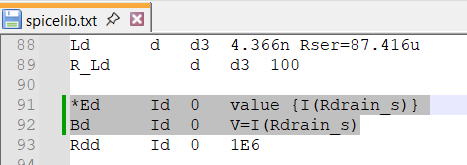
Fatal error: ED•X2: unknown controlling source RDRAIN_S•X2
This is where the error is. Change the E-source to a B-source; that E-source syntax was really old. mosfet_test-KSK.qsch (6.3 KB) spicelib-qspice.txt (14.8 KB)
That model worked, but the MOSFET model encountered issues in a different circuit. Currently, I prefer LTspice over Qspice for simulating component SPICE models.
I also have the impression that these FET models, which are full of equations and tables, pose a challenge to Qspice. They are commonly used by Infineon, Wolfspeed, etc., to describe SiC or MOSFET devices. These models were likely designed with LTspice, as you can find example circuits using them with LTspice—which sometimes even explain how to adjust the .option parameters in order to run them. I recall playing with an example, and it worked until I changed a certain device value. It looks like the official example is somehow only marginally working. In general, my feeling is that these models are very inefficient, and I tend to replace them with FETs modeled using the Qspice Model Generator. I am normally impatient when working with such complicated models, as they make troubleshooting very difficult.
I recall talking to Mike about these models. I think Mike doesn’t want to spend much time on them because they don’t make much sense. If you look into their netlists, they model a device with multiple table formulas—which is more of a PWL simulator approach. I always wonder what is the background of this modeling method. Not sure if any expert in forum know the history.
From my experience, sometimes what makes a certain type of model pose a challenge to Qspice may be related to how Qspice responds to an equation. We have had several successful experiences in identifying where to fix or improve things, but it is a very demanding job to pinpoint the exact issue. I guess the real challenge is whether it is worth it for Mike or the community to spend time increasing the robustness of Qspice to handle such weird SPICE models.
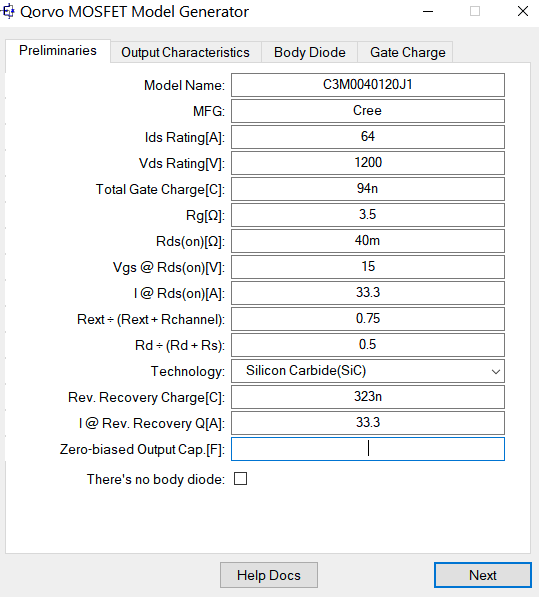
Thank you for the effort and the excellent explanation. Yes, I agree with you, modeling the FET using a model generator is the best choice if we are still using Qspice. Could you please to check my preliminaries parameters, especially for:
Rext : (Rext+Rchannel)
Rd : (Rd+Rds)
Zero-biased output capacitance
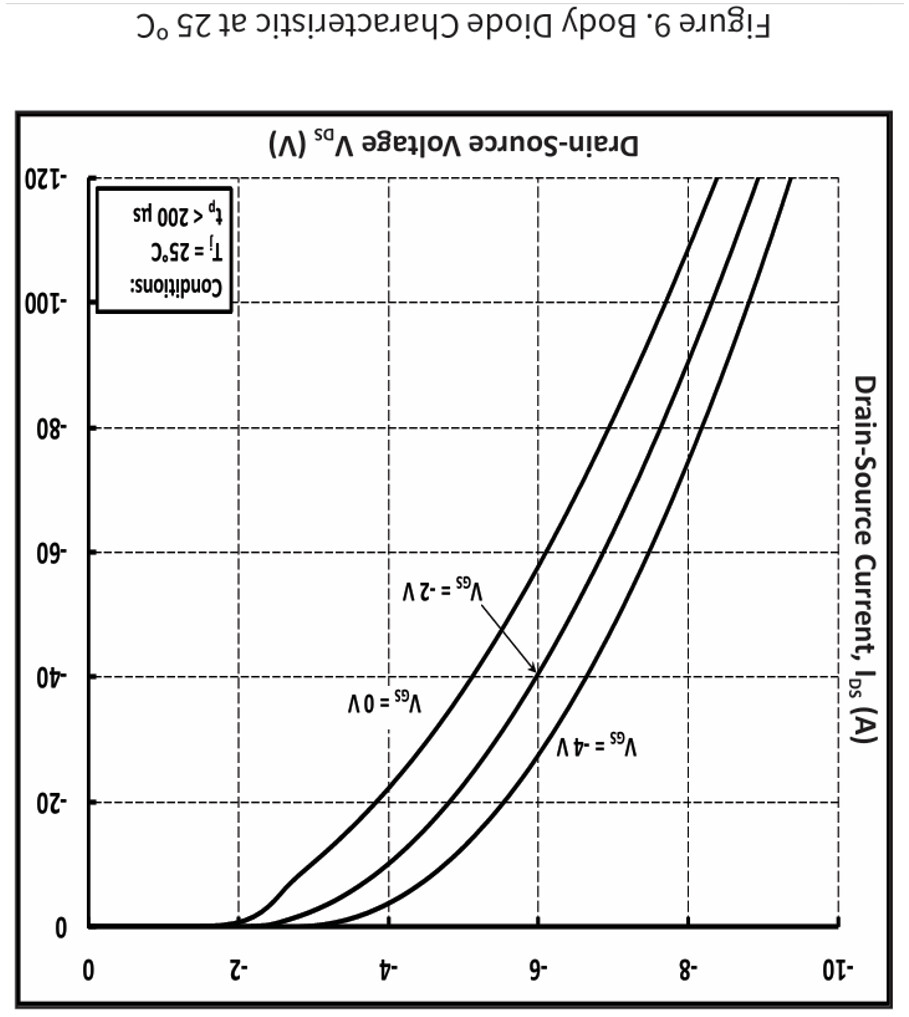
*and a bit confused with negative graph of body diode
I normally copy and paste that negative body diode graph into powerpoint and flip it.
I have an unofficial model generator user guideline in my Github, this is direct download link for that.
I’ve helped model Infineon transistors on the LTspice forum several times. I discovered small inductances in the models. I shunted them with resistors. After some time, I noticed these resistors in the new models. I think the guys from Infineon noticed my trick. Well, my opinion about these models is that they’re suitable for modeling the simplest circuits. I came to this conclusion while using LTspice.