I’m trying to understand the reliable AoA measurement limits of the system.
Why does the Qorvo documentation seem to suggest that we can obtain good angle estimations from -90º to +90º (or quite close to those limits, as seen in Figures 10, 11, 12, and 13 of the APS330 AoA Design Guide, where a one-to-one relationship between the real angle and PDoA is eventually achieved)?
However, both my preliminary tests and the references I’ve found indicate that we will only be able to measure reliably from approximately -45º to +45º before phase wrapping occurs. What causes this huge discrepancy?
Any clarification would be highly appreciated. Thanks!
I am using the official evaluation kit with the default antenna array and default SDK configuration.
Since the physical distance is already the optimal ~0.45*lambda as you mentioned, mathematically it shouldn’t reach the ±180º phase wrapping limit. However, in our real-world indoor measurements, the phase wrapping occurs much earlier (around ±45º to ±50º AoA).
Would you say this early wrapping is primarily driven by real-world environmental factors (like multipath reflections altering the phase sum) compared to an ideal anechoic chamber? Any technical insights on what causes this specific limitation in a real indoor setup would be greatly appreciated for my research documentation. Thanks!
Please see typical AoA results achievable as abstracted to an EV heading. The raw position and heading from the PDoA anchor is shown as the gray dot/arrow on the vertical strip chart:
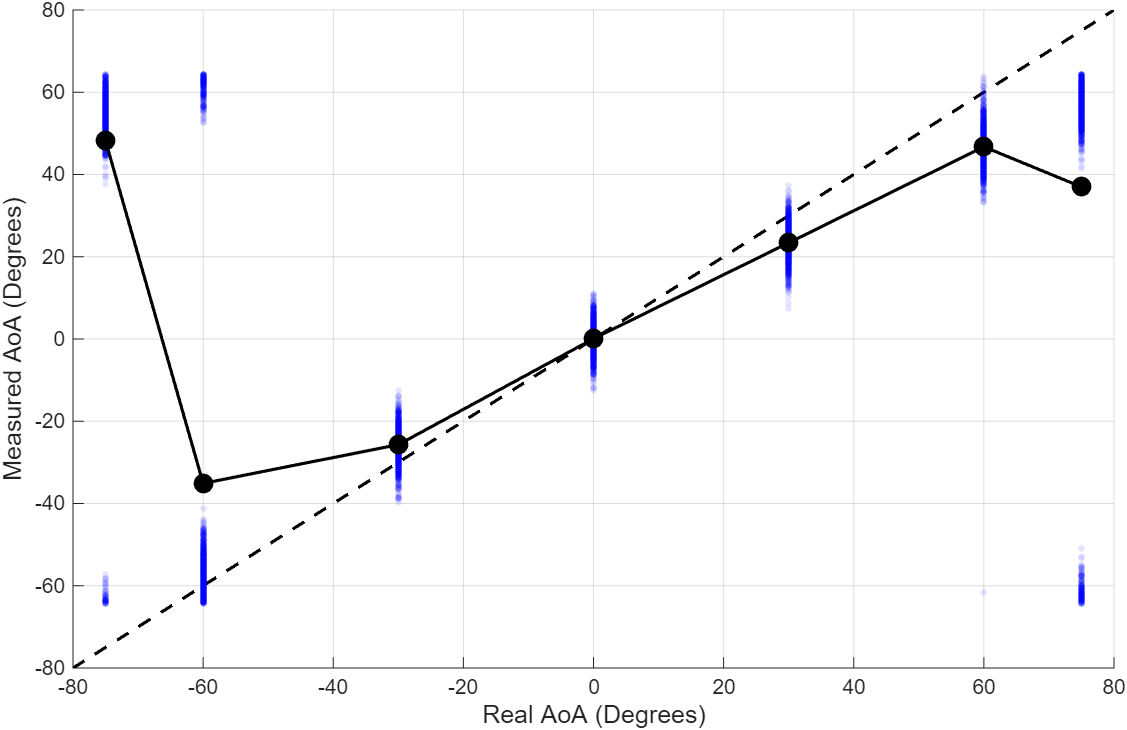
Sure! I have attached a scatter plot showing the Real AoA vs Measured AoA from my tests.
As a quick note on the plot: the blue clusters represent the measurement points, which were taken in steps of 30º. As you can see, the estimations are quite accurate and linear at ±30º, but by the time we reach the ±60º mark, phase wrapping has already kicked in and causes massive measurement errors.
Regarding my testing setup:
Environment: Standard indoor hallway (so multipath reflections from walls and floor are present).
Physical Setup: Both boards are mounted on tripods at the exact same height, with a fixed distance of 2 meters between them (clear Line of Sight). I used an angular scale to manually rotate the receiver to the specific ‘Real Angles’ shown in the plot.
Hardware: Both the Anchor and the Tag are the official QM33120WDK1 evaluation kits using the default antenna array.
Software: Default SDK configuration (no custom PDoA shift or custom LUT applied).
Do you think the multipath reflections in this standard indoor hallway are enough to push the PDoA over the ±180º limit and cause this early wrapping? Or should the default kit be able to handle wider angles even outside an anechoic chamber?