Hello All,
My name is Ben Blackketter and I need your help.
I have been working on this design for 27 years, and now it is nearly perfected.
SPICE agrees with Falstad and my own calculations == it works.
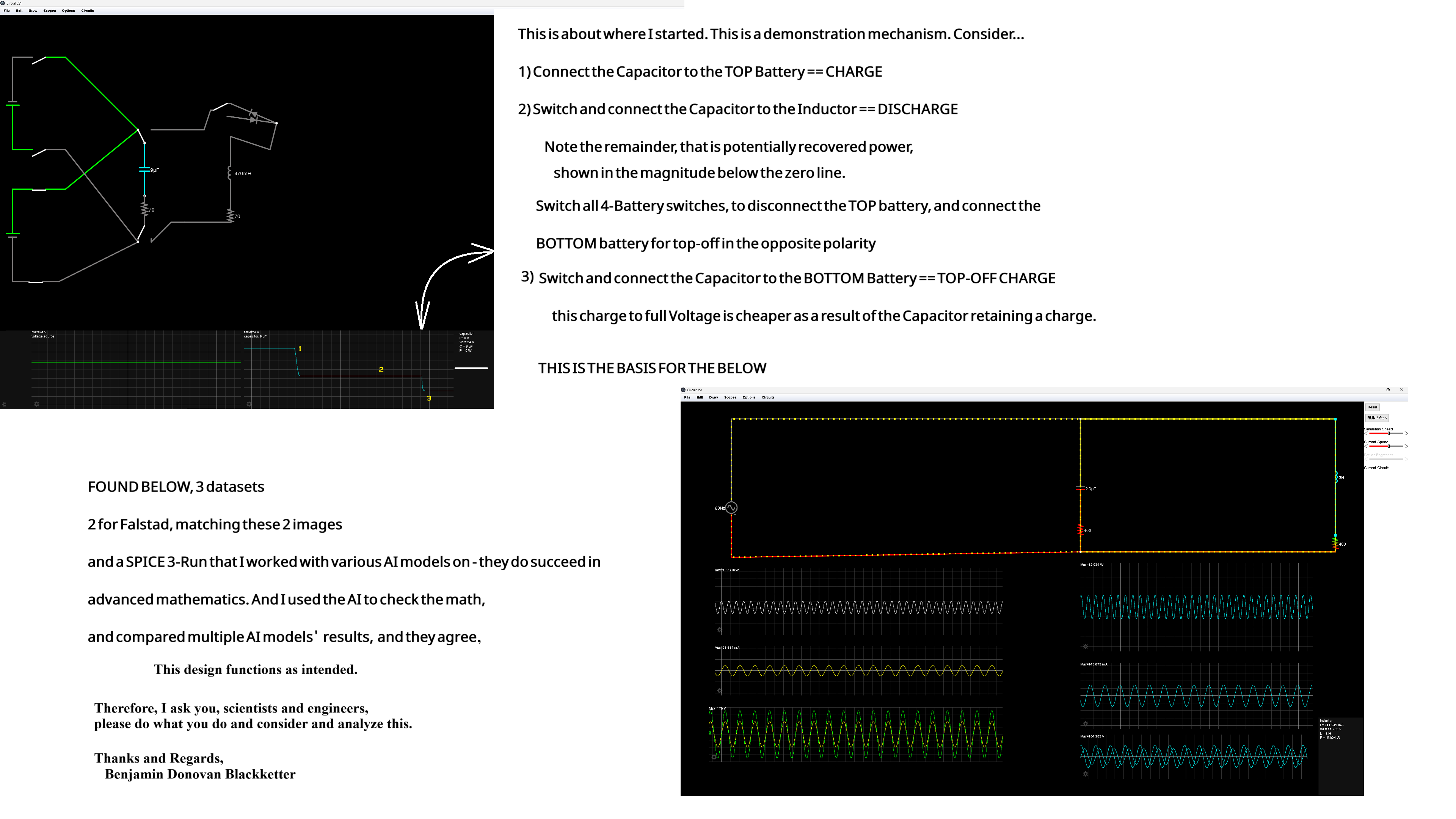
Following are 3 Datasets, top to bottom.
Falstad for top-image
Falstad for second-image
SPICE dataset 3-Run which the AI had to help me with,
but over weeks we refined, and Github Copilot AI (Microsoft)
and Google Gemini agree.
Here is what they say about my questioning the Bneg that was added by AI/SPICE.
NOTE the circuit takes ‘a moment’ to stabilize,
so please give it a second or two of actual run time before expecting the described results.
=====
FIRST/TOP DEMONSTRATION Falstad Circuit Image Dataset
$ 0 0.000005 8.281975887399955 64 5 50 5e-11
v 176 -16 176 208 0 0 40 24 0 0 0.5
c 496 320 496 192 0 0.000009 23.9999999999995 0.001
r 496 320 496 384 0 70
l 704 352 704 176 0 0.47000000000000003 0 0
r 704 352 704 384 0 70
S 496 192 496 160 0 0 false 0 2
S 496 384 496 432 0 1 false 0 2
w 560 384 512 432 0
w 704 384 592 384 0
w 560 160 640 160 0
S 656 112 704 112 0 0 false 0 2
w 640 160 656 112 0
w 704 176 800 208 0
w 800 208 816 144 0
d 816 144 704 96 3 default
w 592 384 560 384 0
w 560 160 512 160 0
d 704 128 816 144 3 default
s 304 304 176 304 0 1 false
s 288 528 176 528 0 1 false
s 304 208 176 208 0 0 false
s 304 -16 176 -16 0 0 false
w 480 160 304 -16 0
v 176 528 176 304 0 0 40 24 0 0 0.5
w 304 304 480 160 0
w 304 208 480 432 0
w 288 528 480 432 0
o 3 64 0 4097 20 0.1 0 1
o 0 64 0 4098 40 0.1 1 1
o 1 64 0 4098 40 0.1 2 1
=====
SECOND THE NEARLY PERFECTED Falstad Circuit
$ 1 0.000005 3.7524723159601 57 5 50 5e-11
l 1840 288 1840 624 0 3 -0.1456242586114 0
c 1104 400 1104 576 4 0.0000022999999999999996 -95.35367230463028 0.001
r 1104 576 1104 640 0 400
v 96 496 96 592 0 1 60 175 0 0 0.5
w 96 496 96 288 0
w 96 688 1104 672 0
w 1840 288 1104 288 0
w 1104 288 1104 400 0
w 1104 288 96 288 0
r 1840 624 1840 672 0 400
w 1104 672 1840 672 0
w 1104 640 1104 672 0
w 96 592 96 688 0
403 32 1120 880 1280 0 3_64_0_x83013_174.99999999999994_0.09564113276732739_-1_2_50_0_3_3_0.05_0
403 48 944 880 1088 0 3_64_0_4097_320_0.4_-1_2_3_3
403 48 720 880 912 0 3_64_7_4099_320_0.1_-1_1_40
403 1104 704 1776 960 0 0_64_7_4099_320_0.2_-1_1_40
403 1104 992 1776 1184 0 0_64_0_4097_320_0.4_-1_2_0_3
403 1104 1200 1760 1328 0 0_64_0_4099_320_0.4_-1_2_0_3
=====
THIS is the 3-Run SPICE dataset that was necessary for me to convince the AI
that the circuit’s effect would not vary of fade over time. Thus 3-Run.
- LCRVF_sweep_3run.cir
- 3-run sweep of negative conductance gneg (no .fourier in this file).
- Use this to locate candidate gneg values quickly (fast-ish runs).
- Circuit:
- V1 → node n1
- branch A: L1 (3 H) → nL → R_L (400) → 0
- branch B: C1 (2.3uF) → nC → R_C (400) → 0
- active : Bneg from n1 to 0 implementing I = gneg * V(n1)
- Notes: no .fourier here (safer for stepped sims). After finding best gneg,
- run the single-case netlist (provided separately) at that gneg to extract phasors.
.param Freq=60
.param Vpk=175
.param Tstop=12
-
Source
V1 n1 0 SIN(0 {Vpk} {Freq}) -
Inductive branch
L1 n1 nL 3
R_L nL 0 400 -
Capacitive branch
C1 n1 nC 2.3u
R_C nC 0 400 -
Behavioral negative conductance (stepped)
-
Use I = gneg * V(n1). gneg will be set by .step values.
Bneg n1 0 I={ gneg * V(n1) }
.options numdgt=9
.tran 0 {Tstop} 0 1e-6 startup
.save V(n1) I(V1) I(L1) I(C1) I(Bneg) V(nL) V(nC)
- ---- measurements for the sweep (numeric FROM/TO to avoid parser issues)
.meas Vsrc_rms RMS V(n1) FROM=6 TO=12
.meas Isrc_rms RMS I(V1) FROM=6 TO=12
.meas I_L_rms RMS I(L1) FROM=6 TO=12
.meas I_C_rms RMS I(C1) FROM=6 TO=12
.meas Psrc_avg AVG V(n1)*I(V1) FROM=6 TO=12
.meas P_Bneg_avg AVG V(n1)*I(Bneg) FROM=6 TO=12
.meas P_L_avg AVG V(n1,nL)*I(L1) FROM=6 TO=12
.meas P_L_abs_max MAX ABS(V(n1,nL)*I(L1)) FROM=6 TO=12
.meas P_L_abs_avg AVG ABS(V(n1,nL)*I(L1)) FROM=6 TO=12
.meas P_RL_fromRMS param ‘I_L_rms * I_L_rms * 400’
.meas P_RC_fromRMS param ‘I_C_rms * I_C_rms * 400’
.meas P_resistors_fromRMS param ‘P_RL_fromRMS + P_RC_fromRMS’
.meas Energy_balance_err param ‘Psrc_avg + P_Bneg_avg + P_resistors_fromRMS + P_L_avg’
.meas S_src param ‘Vsrc_rms * Isrc_rms’
.meas PF param ‘Psrc_avg / S_src’
.meas R_limit param ‘Vsrc_rms * Vsrc_rms / (abs(Psrc_avg) + 1e-20)’
-
Per-cycle diagnostics (optional)
.meas P_L_cycle_1 AVG V(n1,nL)*I(L1) FROM=6 TO=6.01666666667
.meas P_L_cycle_2 AVG V(n1,nL)*I(L1) FROM=6.01666666667 TO=6.03333333333 -
---- 3-run explicit list (exactly 3 simulations)
.step param gneg list -6e-4 -5.4639e-4 -4.8e-4